

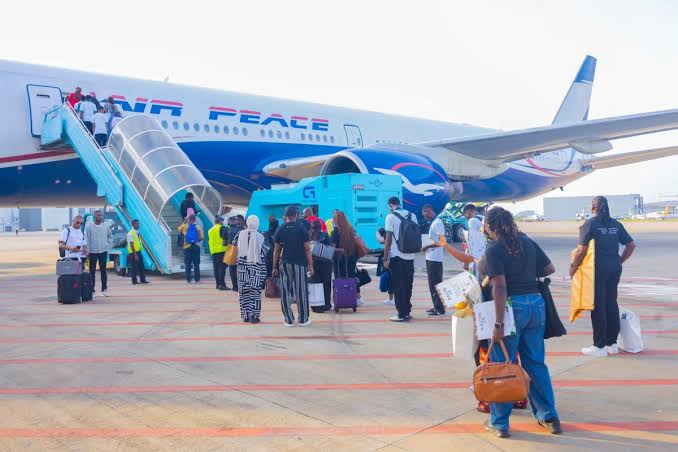
For about seven hours from 5am on August 12, flight operations principally of Air Peace
were disrupted as a result of blockades and picketing of the terminals of the airline in Lagos, Abuja and Enugu by protesting labour unions.
Affiliates of the Nigeria Labour Congress (NLC) and Trade Union Congress (TUC) namely the National Union of Air Transport Employees (NUATE), Air Transport Services Senior Staff Association of Nigeria (ATSSSAN) and National Association of Aircraft Pilots and Engineers (NAAPE) had undertaken the action in pursuit of specified grievances.
These included the alleged refusal of domestic airlines to remit to the appropriate authorities the sum of at least N30 billion already collected from passengers as statutory Ticket Sales Charge (TSC) as well as the alleged practice by some airlines of refusing to allow their employees join trade unions of their choice.
At the expiration of a three-day notice of strike reportedly issued by the aggrieved unions, they had, on August 4, announced their readiness to commence industrial action without notice at any time. Although Air Peace was the main target of the disruptions, some other airlines such as United Nigeria Airlines, Max Air and Enugu Air were also tangentially affected by the disturbances.
The first noticeable and inexplicable anomaly was that while the alleged infractions protested against concerned all domestic airlines, Air Peace was specifically targeted. This suggests that there may have been underlying motives for the action that remain unexplained.
Again, the issue of remittance of the Ticket Sales Charge, a statutory levy collected by airlines on behalf of such aviation agencies as the Nigeria Civil Aviation Authority (NCAA), the Nigerian Airspace Management Agency (NAMA), the Nigerian Meteorological Agency (NiMet), the National College of Aviation Technology (NCAT) and the Nigerian Safety Investigation Bureau (NSIB), has been in contention among aviation stakeholders for some time.
The unions may have a valid point that this fund is meant to strengthen the funding of aviation agencies and has implications for the welfare of workers. But it is difficult to understand why the labour unions must seek to enforce the collection of a statutory levy payable to aviation agencies, which have legal means of enforcing their rights. In any case, Air Peace has explained that this is a matter that it is currently engaged in dialogue with the NCAA on.
In the same vein, if the domestic airlines are violating the constitutional rights of their workers to join labour unions, legal channels for seeking redress should be followed rather than resort to self-help. It is instructive that even as the terminals of Air Peace were picketed, some employees of the organisation staged a counter-protest insisting that they had been satisfactorily relating with the management over the last 12 years without being members of organised unions.
We agree with the Aviation Safety Round Table Initiative (ARI) that the action of the unions in this instance was needlessly disruptive and suspiciously selective.
Furthermore, it breached provisions of the Civil Aviation Act and the Trade Disputes Act, which prohibit blockades and disruptions within aviation facilities. As the ARI pointed out, the grievances of the unions could have been pursued at the corporate headquarters of domestic airlines rather than at airport terminals.
The aviation sector unions know better than anyone the sensitive nature of the operations of the industry and the implications of disruptions and disturbances, particularly for safety of human lives. It is estimated that Air Peace lost at least N1billion to this disruption, with 50 per cent of its daily flights cancelled. This has serious negative implications for the country’s economy.
Scores of passengers missed their flights due to cancellations or delays and the consequences in many cases may be irreversible. It is even more condemnable and inexcusable that the disruptions by the unions occurred while mediations by the aviation minister were ongoing.